
What really goes on in a French lesson?
- Valérie Tournié
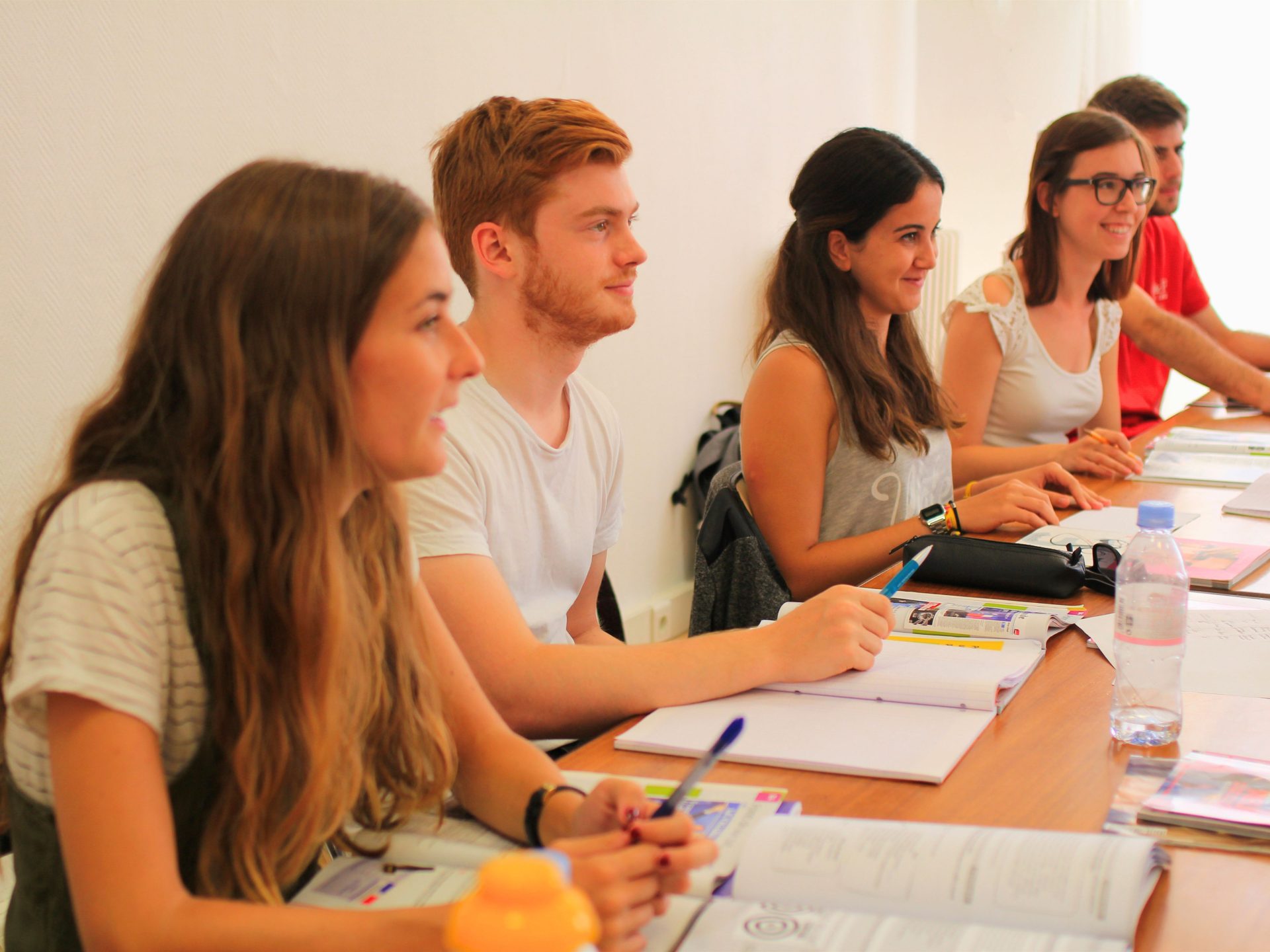
9.00 am. The learners take their seats in the classroom. Some already know each other; others are meeting for the first time. The teacher asks a question. A few pairs of eyes meet; a hesitant reply is given, and then the conversation gets underway. Welcome to a French lesson. Here, we learn the language, of course. But above all, we practise it.
9.05 am: the floor is open for discussion
No time is spent copying rules into a notebook. The session begins with a question, a picture, a situation to comment on or a topic for discussion. Everyone searches for the right words, forms a sentence, listens to others and builds on their answers.
Speaking a foreign language takes practice. You need to learn how to draw on your vocabulary quickly, construct a sentence, and rephrase things when you can’t think of the right word. The activities on offer therefore place a strong emphasis on conversation and real-life communication situations.
The aim: to make French a language that people feel confident using, even when they haven’t yet mastered it perfectly.
9.30 am: mistakes also come up in conversation
«How do you say that again…?» A moment’s hesitation. A mistake in verb conjugation. A sentence that you rephrase. In a language lesson, mistakes aren’t just a hiccup: they’re part of the learning process.
The teacher listens, guides, corrects and explains. They may revisit a grammatical structure, clarify the meaning of an expression or suggest an alternative way of phrasing it. Correction then becomes a tool for progress rather than simply a check of what is right or wrong.
Knowing a rule does not necessarily mean knowing how to use it instinctively. Grammar only really comes into its own when it enables you to recount an experience, defend an opinion or understand a conversation.
10.00 am: two, three, sometimes fifteen ways of saying things
The tables are moved closer together. Work continues in pairs or small groups. The task is to prepare a dialogue, resolve a situation, discuss an issue or carry out an activity together.
This approach provides plenty of opportunities to practise. It also allows pupils to hear different accents, different ways of phrasing things and different ways of constructing sentences. In a French class, pupils come from different backgrounds and nationalities, but the language becomes common ground.
Gradually, the learners start to take the initiative: they ask a question, seek clarification or rephrase an idea. Autonomy cannot be imposed; it is built up by gradually giving everyone the means to communicate for themselves.
10.30 am: France enters the room
A French lesson isn’t just about the French language. It might also focus on a film, a song, an article, a news story, a social custom or a cultural event.
These resources enable learners to discover different cultures and ways of life whilst developing their comprehension and expression skills. At the Alliance Française in Toulouse, this cultural dimension also extends beyond the classroom thanks to the cultural workshops, tours and activities organised for learners.
French is then practised outside the classroom. It is practised in a museum, on a school trip, during a social gathering or simply on the streets of Toulouse. A real-life situation becomes a new opportunity to understand and communicate.
12.30 pm: the lesson ends, but the learning continues
The exercise books are closed. Yet the lesson isn’t quite over. A phrase heard during the lesson lingers in the mind. A new word is jotted down. A difficulty is identified. And, above all, the next opportunity to speak French is already on the horizon.
After all, making progress in a language also depends on consistency. Lessons provide a framework for learning and practising, but progress is fuelled by everything that happens between sessions: listen to a podcast, read an article, watch a film, chat with French speakers or simply try ordering a coffee in French.
Depending on the objectives, learning can take various forms: General French lessons, exam preparation, specific courses or online lessons. The important thing is to find the pace and the course that allow you to practise enough to gradually turn your knowledge into second nature.
One classroom, many ways to learn
So, what actually happens in a French lesson? A bit of grammar, certainly. Vocabulary, reading comprehension and correction too. But above all, people who talk, listen, explore, make mistakes, try again and make progress together.
It is this dynamic aspect of learning that the Alliance Française in Toulouse seeks to bring to life in its courses and the many activities that complement them. Whether you’d like to start learning French, improve your fluency in speaking, to prepare for an exam or simply to practise more, Perhaps the best course is the one that makes you want to carry on speaking French once you’ve left the classroom.
Fancy seeing what’s going on on the other side of the door? Discover the courses and programmes on offer at the Alliance Française in Toulouse and find the one that suits your goals.


 Français
 English (UK)
 Español
